
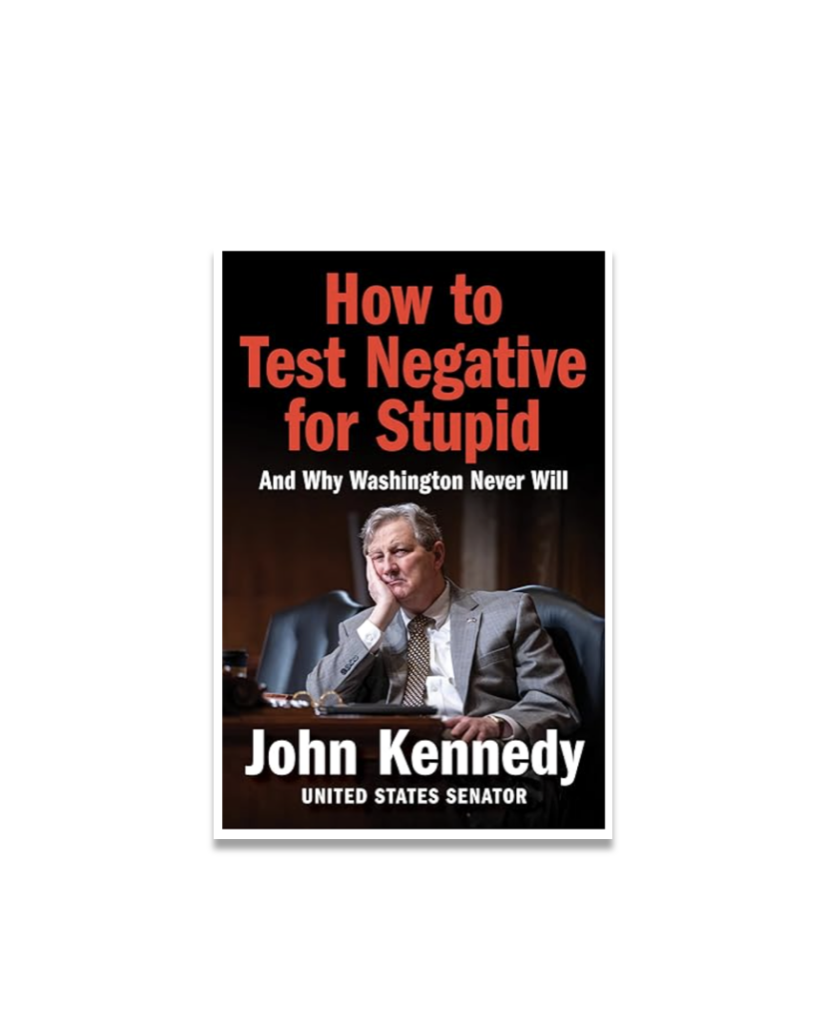
Author: Sen. John Kennedy
Publisher: Broadside Books (2025)
Length: 224 pages
======================================================
How to Test Negative for Stupid by John Kennedy is exactly what you think it is—and not quite what you think it is.
If you’ve ever watched Kennedy on C-SPAN, delivering one of his molasses-slow, drawl-heavy zingers (“You can’t fix stupid, but you can vote it out”), you’ll recognize the tone immediately. The book reads like a front-porch monologue delivered with a glass of sweet tea in hand and an eyebrow permanently arched. It’s part political manifesto, part cultural lament, part stand-up routine.
And yes, it’s funny.
Kennedy’s brand is homespun common sense wrapped in barbed wire. He has a knack for turning policy disputes into punchlines. In this book, he argues that America is suffering from an epidemic of what he calls “weaponized foolishness”—in government, in media, and in everyday life. The title, of course, is metaphorical. There is no nasal swab for stupidity (though if there were, social media would be a testing site). Instead, Kennedy offers a checklist of habits and principles that, in his view, separate sound thinking from sloppy thinking.
The core message is straightforward: personal responsibility matters; common sense is underrated; bureaucracies tend to expand like waistlines at Thanksgiving; and politicians—especially the ones he disagrees with—have an advanced degree in nonsense.
Where the book shines is in voice. Kennedy writes the way he speaks, and unlike many politicians’ books (which often feel like they were ghostwritten by a committee of exhausted interns), this one feels authentically Kennedy. The humor lands more often than it misses. His metaphors are delightfully Southern and occasionally absurd. At one point, he compares certain Washington policies to “putting perfume on a goat and calling it a debutante.” That image sticks with you.
The conversational style makes complex issues accessible. He distills debates about spending, regulation, and cultural flashpoints into plain English. You may not agree with his conclusions, but you’ll rarely struggle to understand what he’s saying. In an era when political language often sounds like it was filtered through a malfunctioning think tank, clarity is refreshing.
That said, the book’s greatest strength is also its limitation.
Kennedy excels at diagnosis; he’s less compelling at prescription. He can skewer government waste with surgical precision, but when it comes to detailed policy blueprints, the discussion tends to stay at 30,000 feet. Readers looking for granular legislative proposals may feel like they ordered a five-course meal and received a very entertaining appetizer.
There’s also the matter of audience. This is not a bipartisan love letter. Kennedy writes unapologetically from a conservative perspective. His critiques of progressive politics are sharp and often amusing, but they are unlikely to persuade those already entrenched on the other side. If anything, the book functions more as reinforcement for readers who already nod along when Kennedy appears on cable news.
Still, even critics might appreciate the rhetorical craftsmanship. Kennedy understands timing. He knows when to land a joke and when to pivot to seriousness. Beneath the humor is a genuine concern about institutional trust, civic literacy, and the coarsening of public discourse. He worries that Americans are outsourcing their thinking—to pundits, algorithms, and partisan tribes—and he urges readers to reclaim independent judgment.
One of the more interesting threads in the book is his emphasis on intellectual humility. It’s somewhat ironic in a book with such a cheeky title, but Kennedy argues that the first step in “testing negative for stupid” is recognizing that you might occasionally be wrong. That theme could have been developed more fully, but its presence adds dimension beyond the punchlines.
Stylistically, the book moves quickly. Chapters are brisk, often structured around a single theme or target. The pacing keeps the reader engaged, though at times it can feel like scrolling through a greatest-hits compilation of Kennedy’s televised remarks. There are moments when you sense that you’ve heard this joke before—perhaps because you have.
The larger question is whether humor is enough. Can wit carry the weight of serious national challenges? Kennedy seems to think humor is a tool—a way to lower defenses and smuggle in arguments about debt, governance, and civic responsibility. In that sense, the book succeeds. It entertains while it agitates.
As a piece of political literature, How to Test Negative for Stupid won’t reshape the ideological landscape. It won’t convert hardened opponents or unveil sweeping new theories of governance. What it does offer is a clear, confident articulation of one senator’s worldview, delivered with charm and a mischievous grin.
For readers who enjoy politics with a side of satire, it’s a lively read. For those seeking bipartisan bridge-building or deep policy excavation, it may feel more like a rally than a roundtable.
In the end, Kennedy’s book is less about stupidity and more about standards—standards for leadership, for citizenship, and for common sense. Whether you agree with his checklist is another matter. But you’ll likely chuckle at least a few times along the way.
And in today’s political climate, getting a laugh out of Washington might be the closest thing we have to a negative test result.
Rating: 4.9/5