

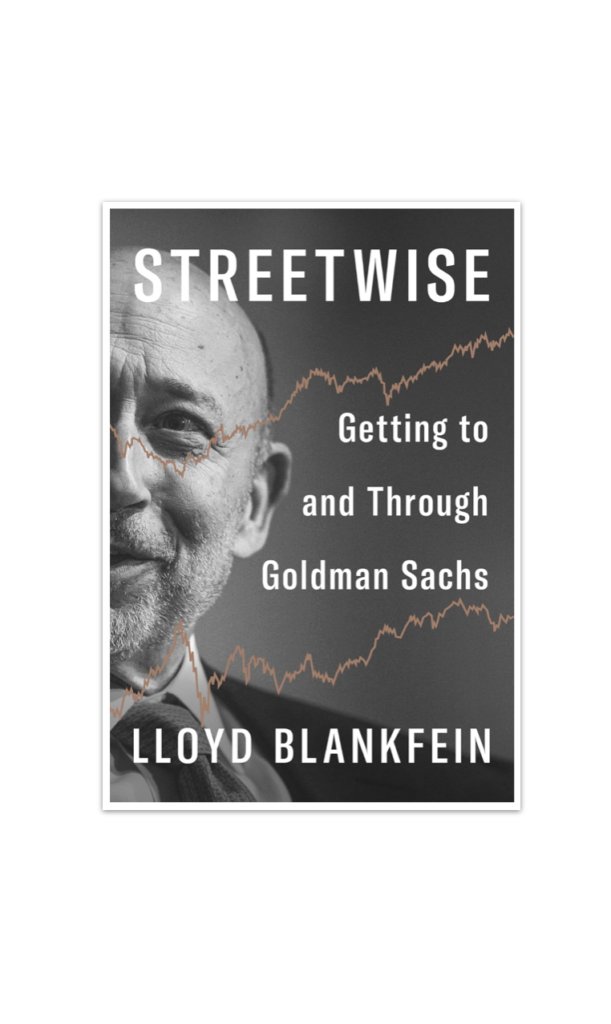
Getting to and Through Goldman Sachs
Author: Lloyd Blankfein
Publisher: Penguin Press (2026)
Length: 400 pages
Lloyd Blankfein’s memoir Streetwise already signals its tone in the title. It’s meant to suggest grit, practicality, and survival instincts—the qualities Blankfein credits for carrying him from a Brooklyn upbringing to the top of Goldman Sachs. The book largely delivers on that promise: a brisk, insider-driven account of Wall Street told by one of its most influential executives. But it also shows the limits of that perspective, especially when it turns to the financial crisis and the public anger that followed.
What makes the book work right away is Blankfein’s voice. He writes in a conversational, often humorous style that feels less guarded than the typical corporate memoir. He comes across as sharp, skeptical, and relentlessly competitive, but also willing to acknowledge the absurdity of the world he operated in. The early sections—covering his upbringing in Brooklyn and his path through Harvard Law School before landing at Goldman—are some of the strongest, precisely because they feel grounded in lived experience rather than institutional language.
Blankfein’s ascent at Goldman is compelling in part because he doesn’t fit the usual Wall Street mold. He emphasizes his middle-class background and outsider status in an environment dominated by Ivy League pedigrees. That sense of being on the outside looking in becomes central to how he frames his success: not as inherited privilege, but as something earned through work ethic, intelligence, and persistence. Readers may or may not accept that framing at face value, but he makes a consistent case for it.
The most gripping sections deal with Goldman’s role during major financial events, especially the 2008 crisis. Blankfein offers a rare inside view of the uncertainty, pressure, and rapid decision-making happening behind closed doors. These chapters move with real urgency—meetings stretching through the night, markets shifting in real time, and enormous financial decisions made under extreme stress. Even readers familiar with the broad outlines of the crisis will likely find these details absorbing.
At the same time, these are also the moments where the memoir’s weaknesses are most visible. Blankfein defends Goldman Sachs and the broader financial system with a consistency that can feel disconnected from how the crisis is remembered publicly. While he acknowledges errors, he often treats criticism of Wall Street as overly simplistic or emotionally driven. That framing can be frustrating, given that for many people the crisis wasn’t just a systems problem—it was a personal and widespread economic collapse.
He clearly wants to argue that financial markets are more complex than popular narratives allow, and he does a good job illustrating just how interconnected and fragile the system had become. But he gives less weight to the sense that public anger was fueled not only by losses, but by the perception that powerful institutions avoided meaningful consequences while others bore the cost. At times, the book reads as if misunderstanding, rather than accountability, is the central issue.
Even so, Blankfein doesn’t entirely sidestep controversy. He does engage with questions around compensation, risk, and corporate culture, even if his conclusions don’t always land convincingly. What emerges most clearly is not a defense that persuades so much as a mindset that explains how someone at the top of that world tends to see it.
The book’s pacing is another strength. Blankfein keeps things moving, balancing technical explanation with anecdotes and humor. Unlike many business memoirs that get bogged down in self-importance, Streetwise is consistently readable. Financial concepts are usually explained in plain language, making the book accessible even without a background in economics.
On a broader level, the memoir touches on meritocracy, capitalism, and inequality. Blankfein views markets as imperfect but fundamentally productive systems that reward skill and discipline. Critics may see that as overlooking how those same systems can reinforce inequality and protect insiders. That tension runs through the entire book and, intentionally or not, becomes one of its most interesting features.
In the end, Streetwise works best as a personal narrative and a window into how elite finance sees itself from the inside. It is less successful as a moral defense of Wall Street, where Blankfein often seems too close to the system to fully grasp why distrust runs so deep. Still, it’s a compelling read—not because it resolves those debates, but because it lays them out plainly through the perspective of someone who lived at the center of them. Readers may not come away convinced, but they will likely come away understanding the mindset—and that alone gives the book its value.