
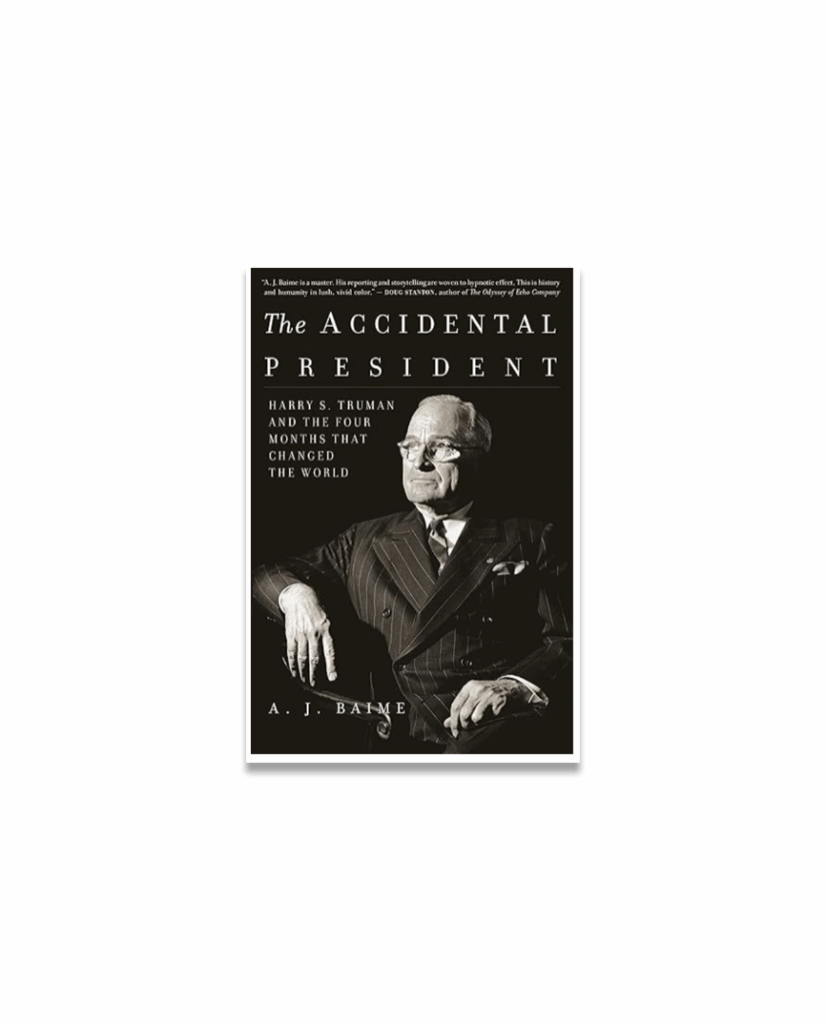
Author: A.J. Baime
Publisher: Mariner Books (2017)
Print Length: 461 pages
=====================================================
Introduction
A.J. Baime’s The Accidental President: Harry S. Truman and the Four Months That Changed the World is a gripping narrative that delves into the early months of Harry S. Truman’s unexpected presidency. With a journalistic flair and a keen sense for drama, Baime offers readers a detailed portrait of a man thrust into the world’s most powerful office during one of the most perilous moments in human history. This review will explore the strengths and weaknesses of Baime’s book, its historical insights, and its effectiveness as a work of popular history.
Summary and Scope
Baime’s book centers on the tumultuous period from April to August 1945, beginning with the sudden death of Franklin D. Roosevelt and Truman’s abrupt ascension to the presidency. Within days, Truman was faced with daunting challenges: the final campaigns of World War II, the decision to use the atomic bomb, the shaping of the postwar world order at Potsdam, and managing relationships with formidable leaders like Churchill and Stalin. Baime organizes the narrative chronologically, allowing the reader to experience Truman’s bewilderment, anxiety, and eventual growth in real-time. The story is rendered with vivid detail, drawing from archival sources, memoirs, and contemporary reporting, which grounds the history in a sense of immediacy.
Strengths
1. Vivid Storytelling and Accessibility
Baime’s writing is accessible and cinematic. He excels at transforming complex historical events into scenes that feel immediate and personal. The opening chapters, which depict Truman learning of Roosevelt’s death and being informed of the Manhattan Project for the first time, are especially gripping. Baime’s talent lies in humanizing Truman—he is not just a historical figure, but as a man anxious about the awesome responsibility suddenly placed upon him.
2. Character Study
One of the book’s most valuable contributions is its nuanced portrait of Truman. Baime is careful to highlight Truman’s humility, doubts, and sense of duty. Unlike many biographies that focus on Truman’s later achievements, Baime zeroes in on the period when Truman was least certain and most vulnerable. This focus makes for a compelling underdog story—a common man who rose to meet unprecedented challenges.
3. Dramatic Context
Baime sets Truman’s struggles against the backdrop of a world in flux. The book does an excellent job of depicting the atmosphere of uncertainty in Washington, the race to end the war, and the high-stakes diplomacy that would shape the modern era. The author’s use of secondary characters—cabinet officials, military advisors, and foreign leaders—further enriches the story.
Weaknesses
1. Limited Depth on Certain Issues
While Baime’s focus on the “four months that changed the world” gives the book its structure and tension, it also creates some limitations. Some readers may wish for more exploration of Truman’s background, motivations, and the long-term consequences of his decisions. For example, the book addresses the use of atomic bombs briefly but does not deeply engage with the ethical debates or the perspectives of Japanese civilians.
2. Occasional Overdramatization
Baime’s penchant for drama, while engaging, sometimes borders on melodrama. There are moments when the writing feels overwrought, as if the stakes need further embellishment. For readers already familiar with the gravity of 1945, this can feel unnecessary.
3. Reliance on Secondary Sources
Although Baime draws on a range of sources, much of the narrative is synthesized from memoirs and previous histories rather than newly uncovered archival material. This makes the book an excellent work of synthesis and storytelling, but less groundbreaking in terms of original scholarship.
Historical Insights
The Accidental President succeeds in reframing Truman’s legacy, showing how the fate of the world hinged on the decisions of a leader who was, by his own admission, unprepared. Baime’s account reminds us that history often turns on contingency and character—qualities that are sometimes overlooked in grand historical narratives. The book also offers valuable insights into the transition of power, the relationship between the executive branch and the military, and the burdens of command during crisis.
Effectiveness as Popular History
Baime’s book is a model of narrative non-fiction. It will appeal to general readers, students, and anyone interested in World War II or presidential history. Its brisk pace and dramatic arc make it a page-turner, while its detailed reconstruction of events ensures its educational value. However, those seeking a more analytical or comprehensive biography of Truman may find the book’s scope too narrow.
Conclusion
In The Accidental President, A.J. Baime delivers a riveting account of a pivotal moment in American—and world—history. The book’s strength lies in its ability to combine historical rigor with narrative excitement, making the story of Harry Truman’s unlikely rise accessible and engaging. While it occasionally sacrifices depth for drama, it remains a valuable and enjoyable contribution to the literature on Truman and the end of World War II.
Rating: 4.4/5