
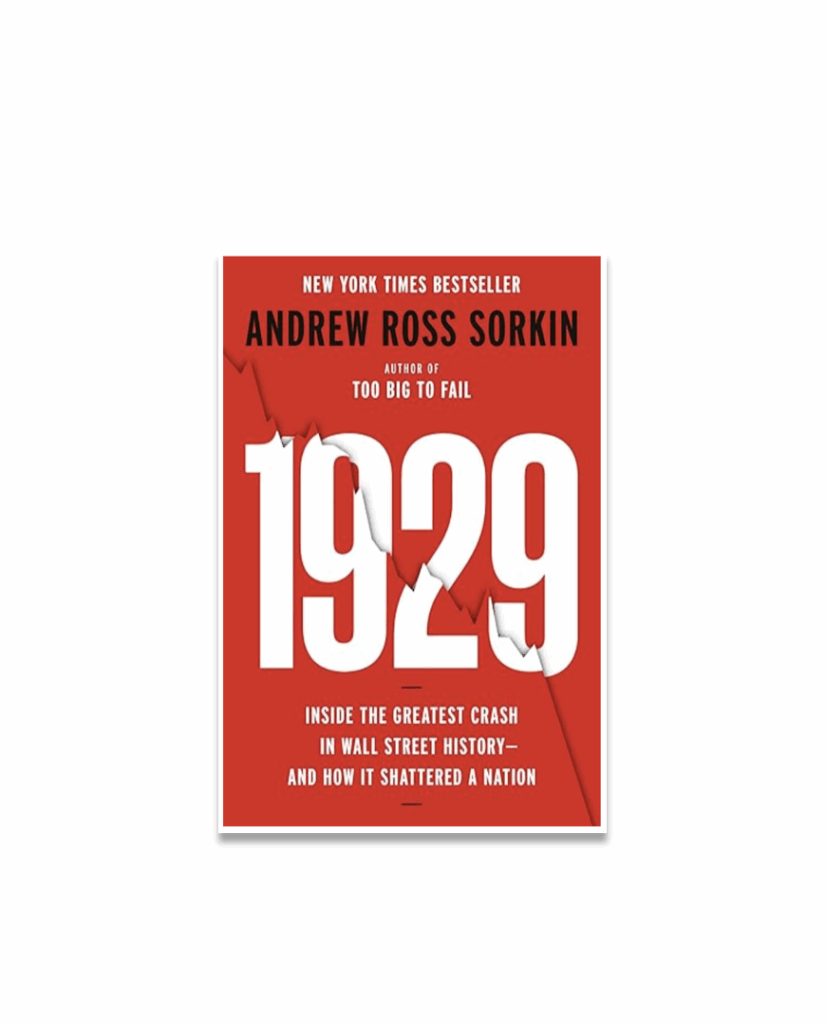
Author: Andrew Ross Sorkin
Publisher: Viking (2025)
Print Length: 591 pages
——————–
Let’s dive into Andrew Ross Sorkin’s 1929: Inside the Greatest Crash in Wall Street History—and How It Shattered a Nation. If the subtitle doesn’t already pull you in, the book itself certainly tries to! Sorkin, well known for his sharp economic reporting, turns his gaze back nearly a century to the infamous stock market crash of 1929, weaving together a vivid narrative of financial excess, hubris, and the unraveling of a nation’s confidence. The question is: does he succeed in making this well-trodden history feel fresh—and does his analysis hold up in today’s world?
One of the book’s standout features is Sorkin’s knack for storytelling. He doesn’t just lay out the facts; he brings the era to life. Through portraits of key figures—bankers, investors, politicians, and everyday people—he paints a picture of America on the brink. The Roaring Twenties, in Sorkin’s hands, isn’t just a backdrop; it’s a living, breathing character. You feel the optimism and wild speculation, the jazz and glitz, the dizzying highs before the devastating lows. What’s particularly engaging is how Sorkin alternates between the boardrooms of Wall Street titans and the sidewalksof ordinary Americans. He doesn’t let you forget that the crash wasn’t just a matter of numbers on a ticker tape—it was about lives upended, dreams broken, and a nation forced to reckon with its own illusions.
Sorkin’s research is meticulous. He draws on diaries, letters, newspapers, and financial records to reconstruct the events of 1929 with remarkable detail. The minutiae—like the panic on the trading floor, the frantic phone calls between bankers, and the rumors that swept through Manhattan—are rendered with a journalist’s eye for telling detail. He also excels at explaining the complex financial instruments and practices of the era, making them accessible without dumbing things down. However, at times, the sheer volume of detail can be overwhelming. Sorkin’s desire to be comprehensive means that some sections bog down in the weeds. Readers looking for a brisk read might find themselves wishing he’d trimmed a bit here and there.
Where Sorkin really shines is in his analysis of what caused the crash and how it reverberated across the country. He’s clear-eyed about the speculative mania that gripped America—margin buying, unregulated banks, and a general sense that the good times would never end. He draws insightful parallels between the psychology of 1929 and more recent financial crises, like the 2008 meltdown (a topic he’s written about before). His chapter on the aftermath is particularly strong. Sorkin traces how the crash didn’t just wipe out fortunes—it shattered faith in institutions and bred a new skepticism about unchecked capitalism. He’s keenly aware of the social and political consequences: the rise of populism, the push for reform, and the long shadow the Great Depression cast over American life.
Despite the book’s many strengths, however, there are a few areas where Sorkin’s approach could be critiqued. For one, his focus is overwhelmingly American. While this makes sense given the subject, the global impact of the crash gets comparatively short shrift. The ripple effects in Europe, Latin America, and beyond are mentioned but rarely explored in depth. This is a missed opportunity, especially since the crash had truly worldwide consequences. Another critique concerns the treatment of historical figures. While Sorkin brings characters to life, he sometimes falls into the trap of oversimplification—casting certain financiers as almost cartoonish villains or hapless fools. The reality, as always, was more nuanced. Not every banker was a villain, and not every investor was naïve. A little more subtlety in these portraits would have made for a richer narrative.
One of the book’s most compelling arguments is that the lessons of 1929 remain urgent today. Sorkin draws persuasive connections between the mood of the late 1920s and the speculative bubbles of the twenty-first century. He warns against complacency and the belief that “this time is different.” It’s a sobering message, and one that feels especially relevant in our own era of economic uncertainty and rapid technological change.
So, who should read this book? If you’re fascinated by financial history, love a good narrative, or want to understand how an economic event can reshape a nation’s psyche, Sorkin’s 1929 is well worth your time. It’s not a breezy read—expect to wade through some dense sections—but it’s consistently insightful and often gripping. In summary: Sorkin’s book is a thorough, dramatic, and cautionary look at the most infamous crash in Wall Street’s history. It’s a potent reminder of how quickly fortunes—and societies—can unravel, and why the lessons of the past still matter today.
Rating: 4.7/5