
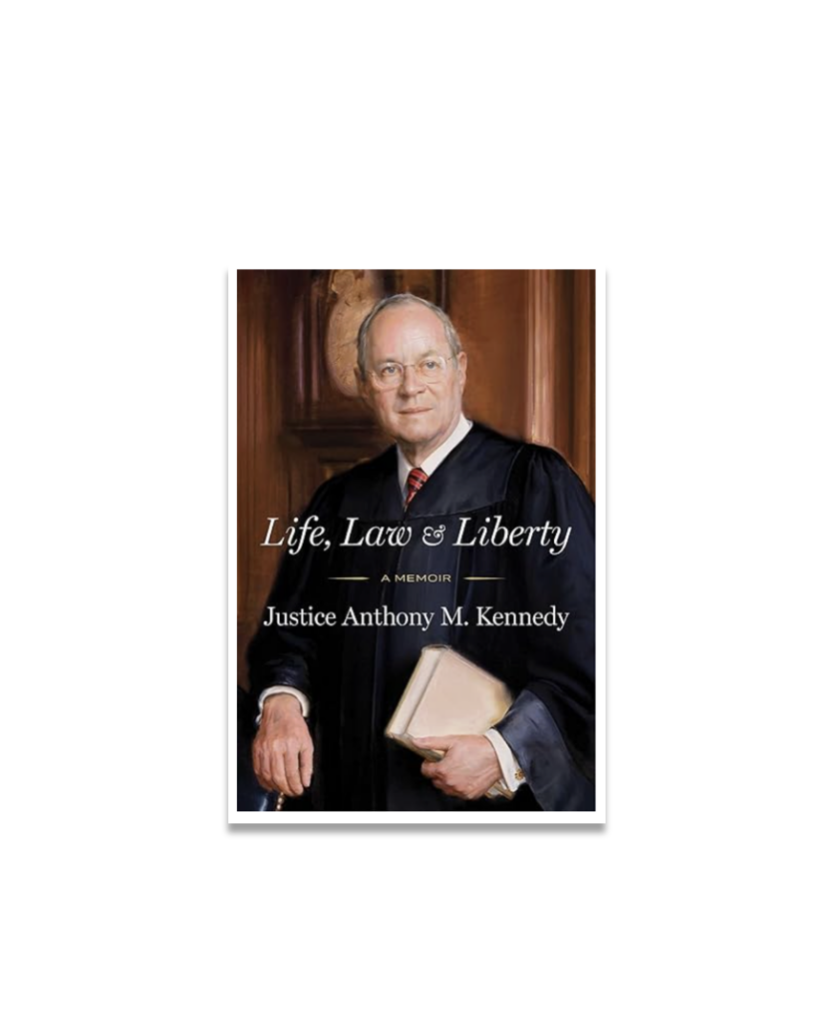
Author: Justice Anthony M. Kennedy
Publisher: Simon & Schuster (2025)
Length: 352 pages
Life, Law & Liberty, the memoir by retired Supreme Court Justice Anthony M. Kennedy, is exactly the book you’d expect from the Court’s longtime swing vote: thoughtful, careful, earnest, and occasionally frustrating in its restraint. It’s not a tell-all, not a score-settler, and certainly not a book designed to trend on social media. Instead, it’s a reflective meditation on law, freedom, and the moral responsibilities of a judge who spent three decades at the center of American constitutional life.
Kennedy structures the book less as a chronological autobiography and more as a series of thematic reflections—on liberty, dignity, democracy, and the rule of law. Readers hoping for juicy behind-the-scenes anecdotes about conference room drama or sharp portraits of fellow justices will quickly realize that this is not that kind of memoir. Kennedy is allergic to gossip. Names are treated gently, disagreements are described abstractly, and institutional respect is never breached. Whether you find that admirable or evasive depends on what you want from the book.
At its best, Life, Law & Liberty offers a lucid window into Kennedy’s judicial philosophy. He returns again and again to the idea that the Constitution is not merely a legal document but a moral one, designed to protect human dignity against the abuse of power. This theme will be familiar to anyone who followed his opinions, especially in cases involving individual rights. Kennedy writes movingly about liberty not as radical freedom, but as ordered freedom—freedom constrained by responsibility, history, and respect for others. It’s old-school constitutional humanism, delivered with sincerity rather than flair.
The prose is clear, measured, and—true to its author—judicious. Kennedy is not a literary stylist in the flashy sense, but he writes with precision and a teacher’s instinct for explanation. When he discusses landmark cases, he focuses less on outcomes and more on first principles: why courts matter, why independence matters, and why judges must resist the temptation to become politicians in robes. For readers interested in how a justice actually thinks, this is the book’s greatest strength.
That said, the book’s caution can also feel like a limitation. Kennedy rarely interrogates his own blind spots or wrestles publicly with the consequences of being the deciding vote in so many divisive cases. There is reflection, but little self-doubt. He acknowledges controversy without fully engaging with critics who argue that his jurisprudence sometimes lacked coherence or placed too much power in the hands of a single justice. At times, the book reads less like a memoir and more like a valedictory address.
Kennedy’s personal life appears mainly insofar as it shaped his reverence for institutions and civic duty. His upbringing in Sacramento, his father’s influence, and his early exposure to law are covered competently but without emotional excavation. Family, faith, and fear—the elements that often humanize public figures—remain mostly offstage. This is a man defined by his role, and even in retirement, he seems reluctant to step outside it.
The most compelling passages are those in which Kennedy warns about the erosion of democratic norms and the growing hostility toward the judiciary. He is clearly troubled by the politicization of the courts and the casual way constitutional guardrails are dismissed in modern discourse. These sections give the book its urgency and relevance. Kennedy is at his most persuasive when he writes not as a former justice, but as a concerned citizen who has seen how fragile the system can be.
Ultimately, Life, Law & Liberty is not a book that will change many minds—but it may steady a few. It’s a reminder of a judicial temperament that valued moderation, deliberation, and institutional continuity. In an era of maximalist arguments and performative outrage, Kennedy’s voice feels almost anachronistic. Whether that feels comforting or inadequate will depend on the reader.
For general readers, this is a thoughtful but restrained memoir. For lawyers, judges, and serious students of constitutional law, it’s a valuable primary document—a clear statement of how one pivotal justice understood his role. For anyone hoping for fireworks, it will disappoint. But for those willing to listen closely, Life, Law & Liberty offers something rarer: a quiet, principled defense of judging as a moral craft rather than a political weapon.
If nothing else, the book makes one thing unmistakably clear: Anthony Kennedy still believes deeply in the idea of the Court—even when the country seems less sure it believes in itself.
Rating: 4.7/5