
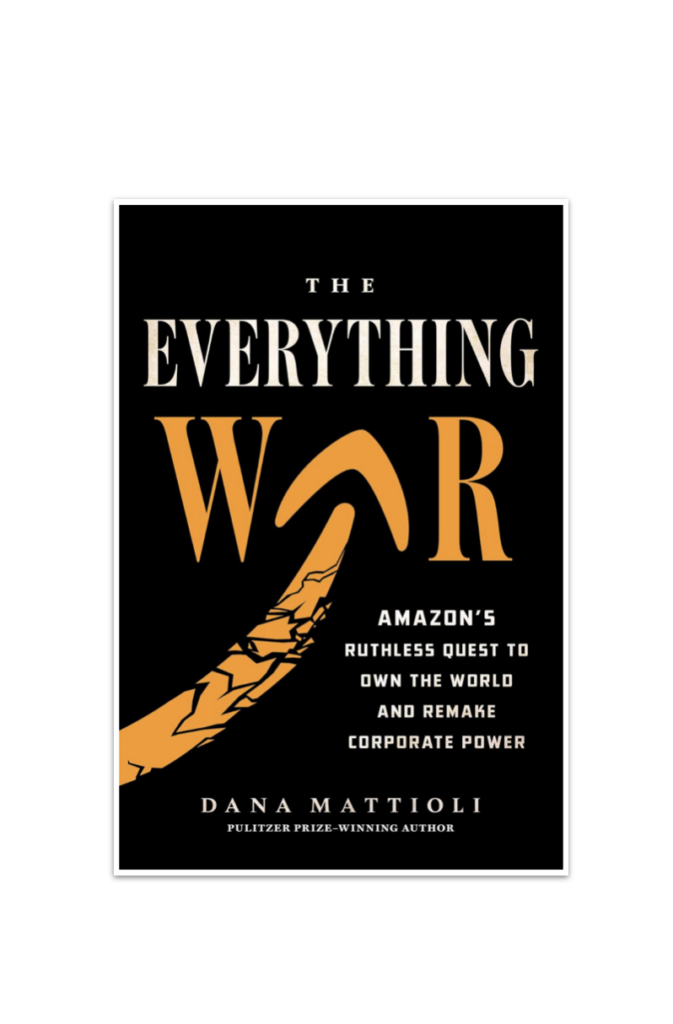
Amazon’s Ruthless Quest to Own the World and Remake Corporate Power
Author: Dana Mattioli
Publisher: Little, Brown and Co. (2024)
Length: 393 pages
When I think about the companies that have reshaped everyday life, few have had an impact as profound as Amazon. It has changed how we shop, how products are delivered, how businesses reach customers, and even how companies think about competition. But behind the convenience of one-click ordering and two-day shipping is a much more complicated story — one of ambition, strategy, and power. Dana Mattioli’s The Everything War takes readers inside that story and offers a fascinating, and at times unsettling, look at how Amazon became one of the most influential companies in modern history.
Mattioli, a Pulitzer Prize winning investigative business journalist with the Wall Street Journal, does not write a simple biography of Amazon or its founder, Jeff Bezos. Instead, she examines the company’s relentless expansion into industries far beyond its original mission as an online bookstore. Her central argument is that Amazon’s greatest competitive advantage was not just technology or efficiency. It was a willingness to enter almost any market, challenge established players, and use its enormous scale to redefine the rules of business.
What makes the book compelling is the reporting behind it. Mattioli draws on interviews with former employees, competitors, industry executives, and people who watched Amazon’s rise from the inside. The result is a portrait of a company that is both admired for its innovation and criticized for the enormous power it accumulated along the way.
One of the themes I found most interesting was Amazon’s willingness to think bigger than almost any traditional company. Most businesses focus on protecting their current market. Amazon often focused on creating entirely new ones. Books led to retail. Retail led to logistics. Logistics led to cloud computing through Amazon Web Services. The company moved into entertainment, advertising, healthcare, groceries, and countless other areas.
That ambition is impressive. Many companies talk about innovation, but Amazon built a culture around experimentation and long-term thinking. Bezos famously encouraged employees to accept failure as part of the process because, without experimentation, major breakthroughs rarely happen. Mattioli shows how that mindset helped Amazon accomplish things that many competitors considered impossible.
At the same time, the book raises important questions about the price of that success. Amazon’s size and influence have created concerns among small businesses, competitors, regulators, and even some employees. Mattioli examines accusations that Amazon has used its marketplace position to compete unfairly with sellers who depend on its platform. She also explores the broader concern that when one company controls so many parts of the buying and selling process, the balance of power can shift dramatically.
The most thought-provoking part of the book is that Amazon is not presented as simply a villain or a hero. That would have made for an easier story, but also a less interesting one. Mattioli recognizes Amazon’s extraordinary achievements while also asking whether a company can become too powerful. The tension between innovation and dominance runs throughout the book.
For business leaders, there are several valuable lessons. First, Amazon demonstrates the importance of customer obsession. The company constantly looked for ways to make life easier for consumers. Second, it shows the power of investing for the long term. Amazon was willing to lose money for years in certain areas because leadership believed those investments would eventually create new opportunities. Finally, the book highlights the importance of understanding how technology can transform an entire industry rather than simply improve an existing product.
My only criticism of The Everything War is that the book occasionally feels so focused on Amazon’s competitive tactics that the human side of the story could have been explored more deeply. Readers may want more insight into the experiences of everyday employees, customers, and small businesses affected by Amazon’s growth. The book is strongest when it examines strategy and corporate power; it is less complete when exploring the broader social impact.
Still, Mattioli has written an important and timely book. Amazon’s story is really the story of modern capitalism — the rewards of innovation, the opportunities created by technology, and the difficult questions that arise when a company becomes extraordinarily powerful.
I finished The Everything War with a greater appreciation for Amazon’s achievements but also with more questions about the future of corporate power. The book challenges readers to consider a difficult question: How much influence should one company have over the way we buy, sell, and do business? Is the book worth your time? Absolutely!
Takeaway for business leaders: Amazon’s success is a reminder that companies rarely become industry leaders by protecting the status quo. They succeed by anticipating change, taking calculated risks, and constantly asking what customers will need next. The challenge is ensuring that growth and innovation remain balanced with responsibility.