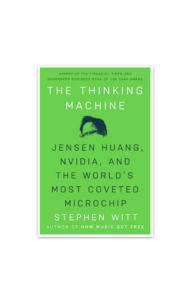

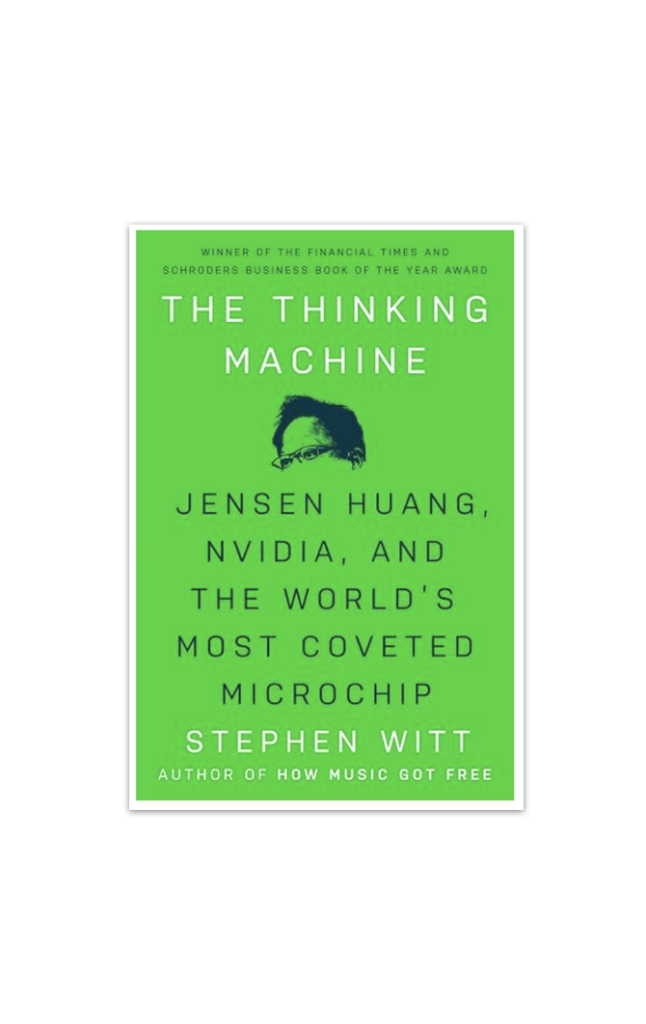
Author: Stephen Witt
Publisher: Viking (2025)
Length: 272 pages
Jensen Huang, Nvidia, and the World’s Most Coveted Microchip
Every so often I pick up a business book expecting a corporate success story and instead find myself reading something that feels more like an epic adventure. Stephen Witt’s The Thinking Machine is one of those books.
At its core, this is the story of Jensen Huang, the leather-jacket-wearing cofounder and CEO of Nvidia, a company that spent decades operating in the shadow of tech giants before suddenly becoming one of the most valuable businesses on Earth. But Witt doesn’t simply tell the story of a corporation. He tells the story of obsession, perseverance, risk-taking, and the strange way technological revolutions often emerge from ideas that initially seem niche or even foolish.
When Nvidia was founded in 1993, few people could have predicted that graphics processors designed to make video games look better would eventually become the engines powering artificial intelligence. Yet that’s exactly what happened. Huang and his team spent years refining technology that most investors barely understood. The result is a company that now sits at the center of the AI revolution.
What makes this book work so well is Witt’s storytelling. He has a journalist’s eye for detail and a novelist’s sense of pacing. The technical concepts are explained clearly enough for non-engineers without oversimplifying the challenges Nvidia faced. Readers don’t need a computer science degree to appreciate why Nvidia’s chips became so important or why competitors spent years trying—and often failing—to catch up.
The book’s greatest strength is its portrayal of Jensen Huang himself. Many business biographies fall into the trap of portraying successful leaders as flawless visionaries. Witt avoids that mistake. Huang emerges as brilliant, demanding, relentless, and at times intimidating. Employees describe a culture that can be unforgiving. Expectations are extraordinarily high, and mistakes are not easily forgotten.
Yet those same qualities help explain Nvidia’s success. Huang was willing to make bets that others considered reckless. He endured near-bankruptcy, technological setbacks, and years when Wall Street largely ignored his company. Reading about those struggles makes Nvidia’s eventual dominance feel earned rather than inevitable.
One of the most fascinating aspects of the book is how it captures the unpredictability of innovation. Looking backward, it’s easy to assume Nvidia’s rise was obvious. Witt demonstrates that it wasn’t. At multiple points, the company could have failed. Competing technologies might have won. Different decisions by customers, regulators, or rivals could have altered the outcome dramatically. The lesson is a valuable one for business leaders: success often looks much less certain from the inside than it does in hindsight.
The book is also a timely examination of artificial intelligence. Much of today’s discussion about AI focuses on software models such as ChatGPT and other generative AI systems. Witt reminds readers that none of these breakthroughs would exist without the underlying hardware. Nvidia’s chips have become the picks and shovels of the AI gold rush. Whether AI ultimately fulfills its promise or falls short of expectations, Nvidia has already positioned itself at the center of the conversation.
My primary criticism is that the book occasionally drifts into hero worship. Although Witt generally maintains journalistic distance, there are moments when Nvidia’s accomplishments overshadow deeper examination of its shortcomings. Questions about concentration of power in the AI industry, geopolitical tensions surrounding semiconductor manufacturing, and the broader societal implications of AI sometimes receive less attention than they deserve.
I also found myself wanting to hear more from the people around Huang. While the CEO understandably dominates the narrative, major technological achievements are rarely the work of one individual. Nvidia’s engineers, researchers, and executives helped build the company, and their stories occasionally feel secondary to the larger-than-life portrayal of its leader.
Still, these criticisms are relatively minor. Witt succeeds in making a highly technical subject both understandable and engaging. That’s no small accomplishment. Semiconductor design is not an easy topic to make entertaining, yet The Thinking Machine reads with the momentum of a thriller.
For business readers, the book offers lessons in leadership, strategic patience, and the importance of long-term thinking. For technology enthusiasts, it provides a compelling behind-the-scenes look at one of the most influential companies of our era. And for anyone trying to understand why AI has suddenly become such a transformative force, it offers essential context.
In the end, The Thinking Machine is less about microchips than it is about vision. Jensen Huang saw possibilities that others missed and spent decades pursuing them. Whether one views him as a genius, a relentless competitor, or some combination of the two, there’s no denying his impact on the modern world.
I closed the book with a deeper appreciation not only for Nvidia’s remarkable journey but also for the countless invisible technologies that shape our lives every day. That’s the mark of a successful business biography: it leaves you understanding both the person and the larger forces at work. Stephen Witt has accomplished exactly that.
A fast-paced, accessible, and insightful look at the company powering the AI age, anchored by a fascinating portrait of one of technology’s most consequential leaders.
Takeaway:
Jensen Huang’s greatest achievement was not building faster chips; it was having the patience and conviction to pursue a vision long before the market was ready. The lesson for business leaders is clear: innovation often requires the courage to invest in an idea that looks premature today but inevitable tomorrow.
Question for Business Leaders:
What long-term investment—whether in technology, talent, or strategy—are you willing to pursue today, even if the payoff may not be visible for years?