

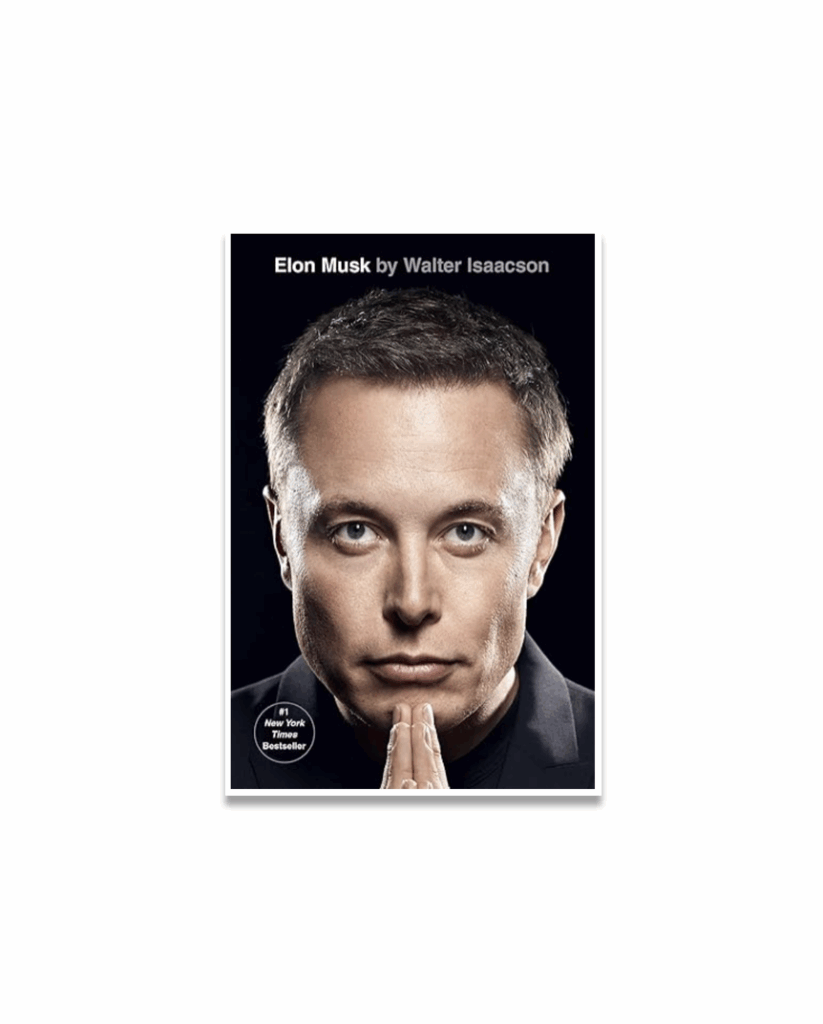
Author: Walter Isaacson
Publisher: Simon & Schuster
Page Length: 688 pages
======================================================
Walter Isaacson’s Elon Musk lands differently when you read it knowing that Musk is now worth roughly $700 billion—a figure so large it almost stops functioning as a number and starts behaving like a plot device. That context matters, because Isaacson isn’t just writing about a quirky billionaire tinkering with rockets and cars; he’s documenting how one intensely driven, deeply volatile person accumulated unprecedented economic and cultural power in real time.
As with Isaacson’s earlier biographies, the defining feature here is access. Isaacson embeds himself with Musk, shadowing him through SpaceX launches, Tesla factory floors, family dinners, and the chaotic takeover of Twitter (now X). The result is a biography that feels immediate and kinetic. You don’t just hear about Musk’s intensity—you feel it. Meetings stretch late into the night, deadlines are impossibly compressed, and crises are treated not as exceptions but as the natural state of things. Isaacson makes it clear that Musk’s success is inseparable from this constant pressure cooker.
The book does an excellent job explaining why Musk’s methods, however brutal, have often worked. Isaacson walks readers through Musk’s obsession with “first principles” thinking and his refusal to accept industry norms. At SpaceX, this mindset helps slash costs and turn reusable rockets from a punchline into reality. At Tesla, it pushes electric vehicles from a luxury curiosity into a mass-market inevitability. Isaacson persuasively argues that few leaders would have tolerated the risk, ridicule, and near-bankruptcy Musk endured—and that the world’s technological trajectory genuinely looks different because he did.
But Isaacson is equally clear that Musk’s personal style is punishing. Musk berates employees, fires people abruptly, and seems almost allergic to emotional consideration. He divides teams, stokes conflict, and openly embraces what he calls “demon mode,” a state where empathy is sidelined in the name of execution. Isaacson doesn’t sanitize this behavior, but he often presents it with a kind of neutral fascination. The damage—to employees, collaborators, and especially Musk’s own family—is visible, yet rarely interrogated with real moral force.
This is where the book’s biggest weakness lies. Isaacson excels at showing what Musk does, but he is less comfortable asking whether Musk should be doing it—or whether his extraordinary wealth and influence demand a higher standard of accountability. When Musk behaves recklessly or cruelly, Isaacson frequently offers psychological context: a traumatic childhood, an abusive father, a lifelong attraction to chaos. Context is useful, but over hundreds of pages it starts to feel like a cushion. Readers may find themselves wanting Isaacson to push back harder, rather than quietly marvel at Musk’s endurance and output.
That hesitation becomes especially noticeable in the chapters on Twitter/X and Musk’s growing political and cultural role. Isaacson reports Musk’s belief in “free speech absolutism” largely on Musk’s terms. The consequences of owning a global communications platform—amplifying some voices, muting others, and reshaping public discourse—are acknowledged but not deeply examined. Given that Musk is not just a CEO but a $700 billion force shaping technology, media, and geopolitics, this light touch feels like a missed opportunity.
Still, one of the book’s strengths is that it resists turning Musk into either a savior or a supervillain. Isaacson captures the contradictions cleanly: Musk wants to save humanity from extinction, yet routinely mistreats the humans closest to him. He champions rationality and data, yet makes impulsive, emotionally charged decisions. He builds extraordinary systems but seems bored—or destructive—once those systems stabilize. These tensions are not resolved, and that unresolved quality feels honest.
Isaacson’s prose is brisk and accessible, even when dealing with complex engineering or financial concepts. The book is long, but it rarely drags, and Isaacson’s conversational tone makes the material approachable for readers without technical backgrounds. At times, though, the flood of anecdotes overwhelms the analysis. The narrative could have benefited from more synthesis and fewer repetitions of Musk blowing something up—figuratively or literally—only to demand more from everyone around him.
Ultimately, Elon Musk reads less like a judgment and more like a case file. Isaacson documents how a man with extreme traits—relentless ambition, emotional volatility, intellectual daring—leveraged those traits into unimaginable wealth and influence. Knowing Musk is now worth $700 billion gives the story extra weight: this isn’t just about personality anymore, but about power. Isaacson gives readers the evidence, the access, and the texture of Musk’s life. What he largely avoids is telling us what it all adds up to. That task, for better or worse, is left to you, the reader.
Rating: 4.6/5