
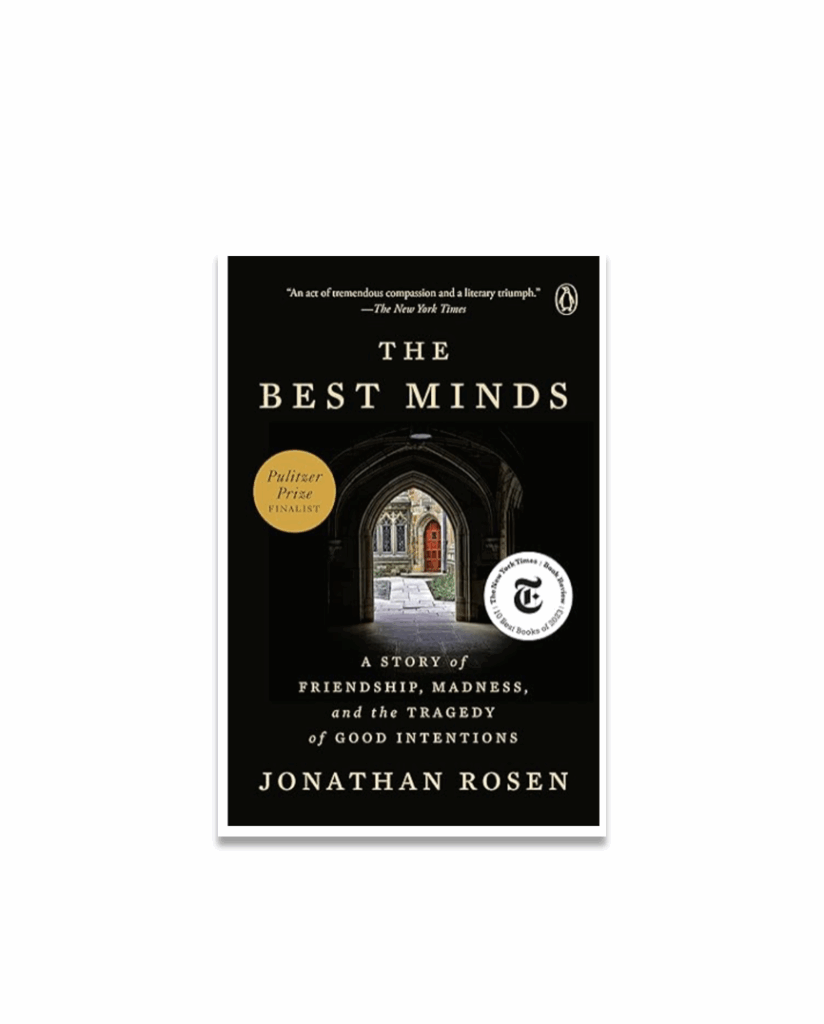
Author: Jonathan Rosen
Publisher: Penguin Press (2023)
Print Length: 576 pages
————————
The Best Minds: A Story of Friendship, Madness, and the Tragedy of Good Intentions by Jonathan Rosen is an intimate, sprawling, and deeply affecting nonfiction account that grapples with the entanglement of brilliance and mental illness. On its surface, it’s a memoir of Rosen’s friendship with Michael Laudor, a prodigy who soared through Yale while battling schizophrenia, only to become the tragic center of a heartbreaking crime. But at its core, it’s much more—a meditation on the limits of idealism, the failings of mental health systems, and the thin line between genius and madness. In this review, I’ll unpack what makes the book so compelling, where it stumbles, and why it’s an essential read for anyone grappling with the complexities of mental health and morality.
Rosen’s narrative begins in the suburban comfort of New Rochelle, New York, where he and Michael Laudor meet as precocious children. Their friendship is at first defined by shared nerdiness and the giddy promise of intellectual adventure. Michael’s mind, even at a young age, is extraordinary; he’s the kind of kid who devours complex texts for fun and discusses philosophy with the ease most kids reserve for baseball stats. But as Michael moves through Yale and, later, Yale Law School, the cracks in his mental health begin to show. Rosen’s recounting of Michael’s struggle with schizophrenia is compassionate and unflinching. He takes us through the euphoric highs of intellectual achievement and the crushing lows of psychotic breaks, all while tracing the arc of a friendship straining under the weight of illness and expectation. What’s especially compelling is how Rosen situates Michael’s personal journey within broader societal hopes. The 1980s and ‘90s were heady times for mental health reform, animated by the belief that with the right support, even the most severe illnesses could be managed, if not overcome. Michael became a poster child for these hopes—a brilliant mind, “recovered” and ready to contribute to the world.
The tragedy at the center of the book—Michael’s violent act during a psychotic episode—forces Rosen and the reader to confront the uncomfortable question: What if good intentions simply aren’t enough? Rosen’s writing here is both brave and generous. He neither demonizes Michael nor absolves him, instead inviting us into the complexity of a system that failed everyone involved. What makes The Best Minds particularly powerful is its refusal to settle for easy answers. Rosen interrogates not just the failings of mental health care, but also the seductive allure of believing that intellect and support can always triumph over biology. The book deftly explores how the optimism of reformers, the ambitions of families, and the hopes of friends can sometimes blind us to the intractable realities of severe mental illness.
Rosen’s prose is elegant, erudite, and often deeply personal. He weaves in references to literature, history, and psychiatry, creating a tapestry that is as much about the cultural history of madness as it is about one man’s life. Some readers may find the asides into philosophy and medical history a little digressive, but for those who enjoy a broad scope, these sections deepen the book’s resonance. Still, there are moments where the narrative can feel a bit unwieldy. Rosen’s intellectual wanderings, while insightful, sometimes pull focus from the immediacy of the story. The book is long and, at times, dense; readers looking for a straightforward memoir may find themselves bogged down in the details.
Strengths:
- Nuanced portrayal of mental illness: Rosen refuses to simplify schizophrenia, showing both its horror and its human context.
- Brave self-reflection: The author is unsparing in examining not just Michael, but also his own motives and blind spots.
- Historical context: The book’s exploration of mental health reform and its unintended consequences is both timely and important.
Shortcomings:
- Occasional narrative sprawl: At nearly 600 pages, the book sometimes loses momentum.
- Potentially overwhelming detail: The breadth of references and side stories, while enriching, might exhaust some readers.
The Best Minds is not an easy read, emotionally or intellectually. But it’s an essential one. Rosen invites us to wrestle with uncomfortable truths: that our best intentions can sometimes go awry; that love alone cannot save someone from the ravages of mental illness; and that society’s progress is often shadowed by its failures. For anyone interested in mental health, the limits of friendship, or the tragedies that can lurk behind even the brightest promise, Rosen’s book is both a cautionary tale and a call for empathy. In the end, The Best Minds leaves us with more questions than answers—but maybe that’s its greatest strength. It reminds us that when it comes to the human mind, humility and compassion are the best guides we have.
Rating: 4.3/5