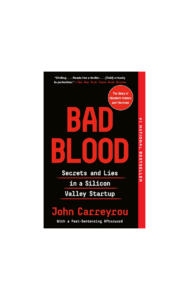

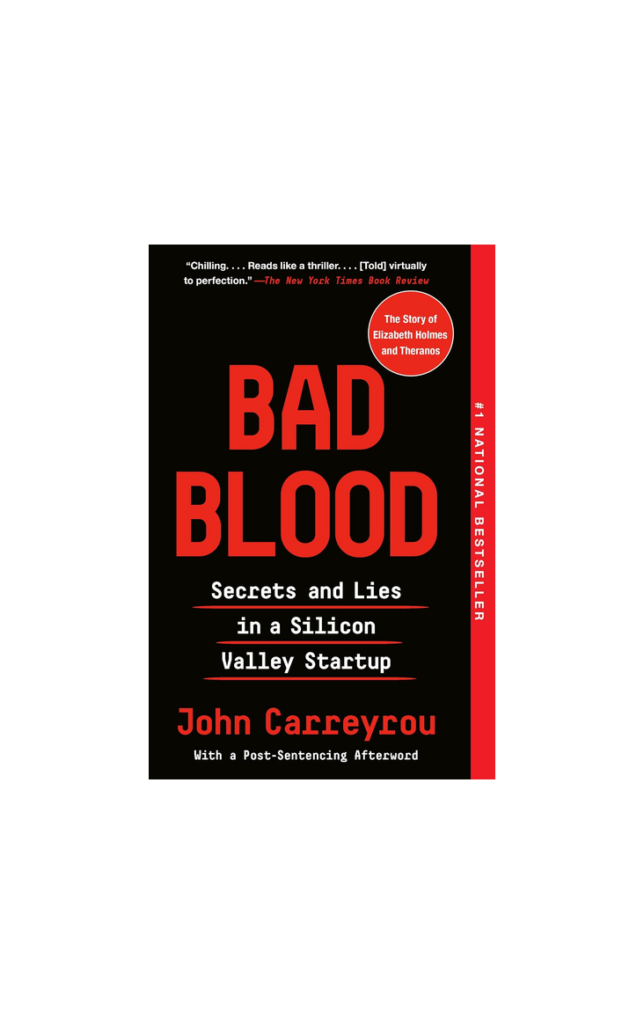
Author: John Carreyrou
Publisher: Vintage (2018)
Print Length: 353 pages
Reviewed by: Jim Kirchner
There is something particularly disturbing about a business executive who builds a multibillion-dollar company on a technology that doesn’t work. It is even more disturbing when that technology is supposed to save lives. In Bad Blood: Secrets and Lies in a Silicon Valley Startup, Wall Street Journal investigative reporter John Carreyrou delivers a gripping account of Elizabeth Holmes, Theranos, and one of the most spectacular business failures in recent memory.
I found this book difficult to put down. It reads less like a business book and more like a corporate thriller, complete with ambitious entrepreneurs, powerful investors, corporate intimidation, whistleblowers, and a journalist determined to uncover the truth. But the most valuable lesson is not about technology. It is about what happens when ambition, ego, and the desire for success overwhelm honesty and sound business judgment.
Elizabeth Holmes founded Theranos in 2003 with an extraordinary promise: a few drops of blood from a finger prick could produce a wide range of medical tests faster, cheaper, and more conveniently than conventional blood draws. The idea was revolutionary. The execution, unfortunately, was not.
Holmes became Silicon Valley’s newest celebrity. She cultivated a Steve Jobs-like image, complete with black turtlenecks, a carefully controlled public persona, and enormous confidence in her company’s potential. Investors, including prominent business leaders and wealthy individuals, poured money into Theranos. At its peak, the company was valued at approximately $9 billion.
There was just one problem. The technology could not deliver what Holmes promised.
Carreyrou does an excellent job explaining how Theranos concealed its technological shortcomings. The company’s proprietary machines could not reliably perform the hundreds of tests Holmes advertised. Instead, Theranos frequently relied on conventional laboratory equipment while continuing to promote its supposedly revolutionary technology.
That deception was not simply an embarrassment for a startup. It potentially endangered patients who relied on inaccurate blood-test results to make important medical decisions.
What makes the story especially compelling is the culture Holmes created. Employees who questioned the technology or raised concerns about its accuracy faced intimidation and, in some cases, termination. Ramesh “Sunny” Balwani, Holmes’s business partner and romantic partner, played a central role in maintaining that environment.
Carreyrou’s reporting reveals a company in which secrecy was mistaken for innovation and loyalty was valued more highly than truth.
The author’s greatest achievement is his portrayal of the people who tried to expose the fraud. Former employees, including Tyler Shultz and Erika Cheung, risked their careers to bring the company’s problems to light. Their experiences demonstrate just how difficult it can be to challenge a powerful executive whose company is celebrated by investors, politicians, and the media.
Carreyrou himself encountered legal threats and extraordinary resistance while investigating Theranos. His persistence is a reminder of the importance of investigative journalism, particularly when powerful companies have the resources to silence critics.
My one significant criticism is that Carreyrou’s account occasionally feels so focused on Holmes’s deception that it leaves the reader wanting a deeper examination of the psychology behind it. How does an intelligent, ambitious entrepreneur convince herself that she can continue making promises that her technology cannot fulfill? At what point does confidence become self-delusion, and self-delusion become deliberate fraud?
The book provides plenty of evidence of Holmes’s behavior, but less insight into the internal reasoning that sustained it. Still, that is a relatively minor criticism of an otherwise outstanding piece of reporting.
The legal consequences ultimately confirmed the seriousness of the deception. In January 2022, Holmes was convicted of four federal counts involving conspiracy and wire fraud against investors. She was acquitted of several patient-related charges, and the jury could not reach unanimous verdicts on others. In November 2022, she was sentenced to 135 months, or 11 years and three months, in federal prison. Her sentence was subsequently reduced to 123 months, or 10 years and three months, in March 2026. Her conviction remains intact.
For business leaders, the lessons are unmistakable. A compelling vision is not a substitute for a viable product. A charismatic founder is not necessarily a competent executive. And a prestigious board of directors is no guarantee that a company is being managed responsibly.
Perhaps the most troubling lesson is that so many sophisticated investors failed to ask the right questions. They were captivated by Holmes’s vision and reputation rather than demanding convincing evidence that her technology worked.
That is a mistake business leaders should recognize. The bigger the promise, the greater the need for independent verification.
Bad Blood is an exceptional piece of investigative journalism and a cautionary tale about corporate governance, leadership, and the dangers of unchecked ambition. It is entertaining, infuriating, and, at times, genuinely chilling.
My verdict: Highly recommended. Every business leader should read this book. Not because Theranos represents an ordinary business failure, but because it illustrates how easily a company’s culture can deteriorate when its leaders believe the rules of business—and the rules of honesty—no longer apply to them.
Jim Kirchner is the founder of ProseandCons.net and author of the Business Books column in Central Penn Business Journal and Lehigh Valley Business. A 37-year veteran of Morgan Stanley, he brings a practitioner’s perspective to his independent reviews and critiques of business books, leadership, technology and entrepreneurship. Visit ProseandCons.net for more.