

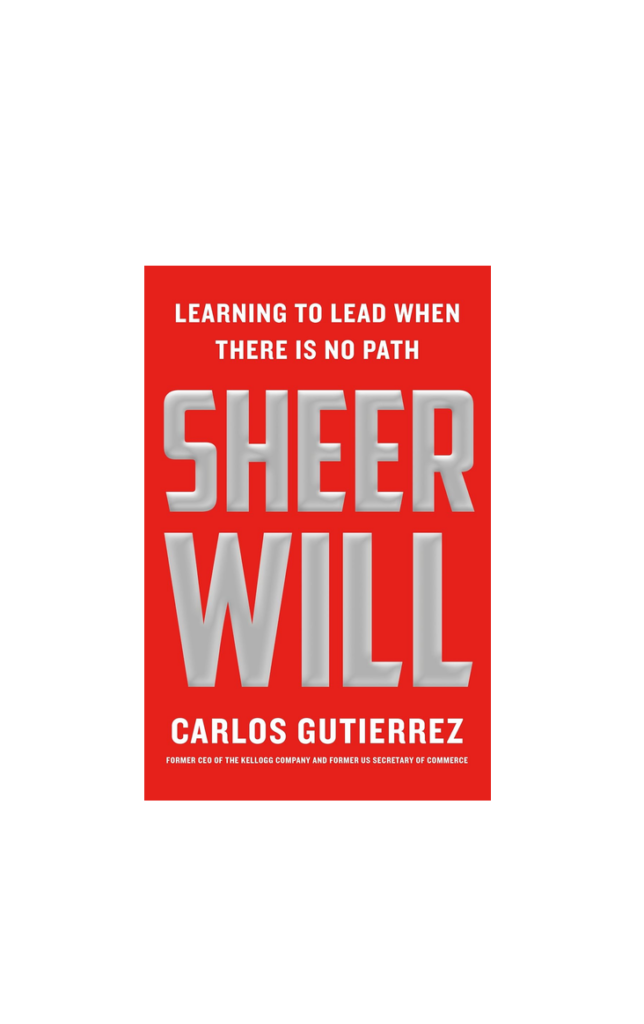
Author: Carlos Gutierrez
Publisher: St. Martin’s Press (2026)
Print Length: 304 pages
Reviewed by: Jim Kirchner
Some business leaders follow a carefully laid-out career plan. Others take a less predictable route, making decisions along the way that eventually lead them somewhere they never imagined. Carlos Gutierrez belongs firmly in the second category.
In Sheer Will: Learning to Lead When There Is No Path, Gutierrez tells the story of his journey from Cuban refugee to chairman and CEO of Kellogg Company and, eventually, U.S. Secretary of Commerce under President George W. Bush. It is an extraordinary journey, made all the more remarkable by the fact that he never graduated from college and arrived in the United States as a young boy without knowing English.
The obvious lesson is that determination matters. But Gutierrez’s story also raises a more interesting question: What separates people who overcome extraordinary obstacles from those who never get the opportunity to do so?
Gutierrez was six years old when his family fled Cuba following Fidel Castro’s revolution. His father, Pedro, had been a successful businessman in Havana. Suddenly, the family had to rebuild its life elsewhere, eventually settling in Mexico. That experience would shape Gutierrez’s understanding of adversity, opportunity and the importance of starting over.
His father’s example appears to have been particularly influential. Losing almost everything did not mean surrendering to circumstances. It meant finding a way forward. That is a lesson worth remembering, especially for anyone who has experienced a professional setback or watched a carefully constructed plan fall apart.
Gutierrez’s own career began far from the executive suite. He joined Kellogg’s Mexican operation as a sales representative, selling cereal out of a van. He ultimately became the youngest CEO in the company’s history. His subsequent move into government gave him another perspective on leadership, one that extended beyond running a major corporation.
That career progression is the book’s central attraction. Gutierrez did not have the conventional credentials that often open doors in corporate America. He had to demonstrate his value through his work.
There is an important distinction here. We often tell young people to work hard, take initiative and make the most of every opportunity. Those are sensible recommendations, but they can sound like slogans when offered by people who have already made it to the top. Gutierrez’s background gives those ideas greater credibility. He knows what it means to begin again, adapt to a new environment and prove yourself without the benefit of an established reputation.
His account of living for decades with undiagnosed attention-deficit/hyperactivity disorder (ADHD), which he learned he had at age 65, adds another dimension. The condition presented challenges in a professional world that prizes organization, consistency and attention to detail. Yet Gutierrez also came to recognize how his way of thinking could help him approach problems differently and act decisively.
That is an appealing reminder that the qualities that make someone’s career difficult are not necessarily the same qualities that prevent success. The challenge is learning how to manage your weaknesses while making the most of your strengths.
Still, there is a potential trap in a story like this. When we look backward at an extraordinarily successful career, it is tempting to connect every decision and experience into a neat progression toward the top. Real life rarely works that way. Hard work and persistence matter, but so do timing, circumstances, relationships and luck. Not everyone who works hard becomes a CEO, and not every career setback can be overcome through a more determined attitude.
That is why the most useful leadership stories go beyond celebrating success. They help readers understand the decisions, mistakes and compromises behind it. Gutierrez’s experience offers plenty of material for that kind of reflection, particularly as he moves between the worlds of business and government. The value for readers will ultimately depend on how candidly he examines not only what worked, but also what did not.
There is another lesson here for business leaders: your background does not have to dictate your future, but it can influence the kind of leader you become. Someone who has experienced uncertainty firsthand may have a different appreciation for risk, opportunity and the people who make an organization successful. That perspective can be valuable in a corporate culture where senior executives sometimes become removed from the everyday realities of their employees.
The title Sheer Will captures the determination behind Gutierrez’s accomplishments. But willpower is only part of the equation. Successful leaders must also recognize their limitations, learn from others, make difficult decisions and adjust when circumstances change. Persistence without judgment can be stubbornness rather than leadership.
Gutierrez’s life is an impressive example of how an unconventional beginning need not prevent an extraordinary career. His rise from a young immigrant to the head of an iconic American company and a member of the president’s Cabinet makes this a story worth considering for anyone interested in business, leadership or personal reinvention.
The most valuable takeaway is not that everyone can become a CEO if they simply work hard enough. It is that a person’s starting point need not determine the limits of their ambition.
That is a worthwhile message. The real test of a leadership memoir, however, is whether it leaves readers with more than inspiration. It should also give them practical insights they can apply to their own decisions and careers.
Gutierrez’s remarkable journey makes the case for perseverance. The lessons that matter most are how to turn that perseverance into sound judgment, effective leadership and lasting results.
Verdict: Recommend
Jim Kirchner is the founder of ProseandCons.net and author of the Business Books column in Central Penn Business Journal and Lehigh Valley Business. A 37-year veteran of Morgan Stanley, he brings a practitioner’s perspective to his independent reviews and critiques of business books, leadership, technology and entrepreneurship. Visit ProseandCons.net for more.