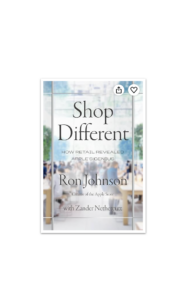

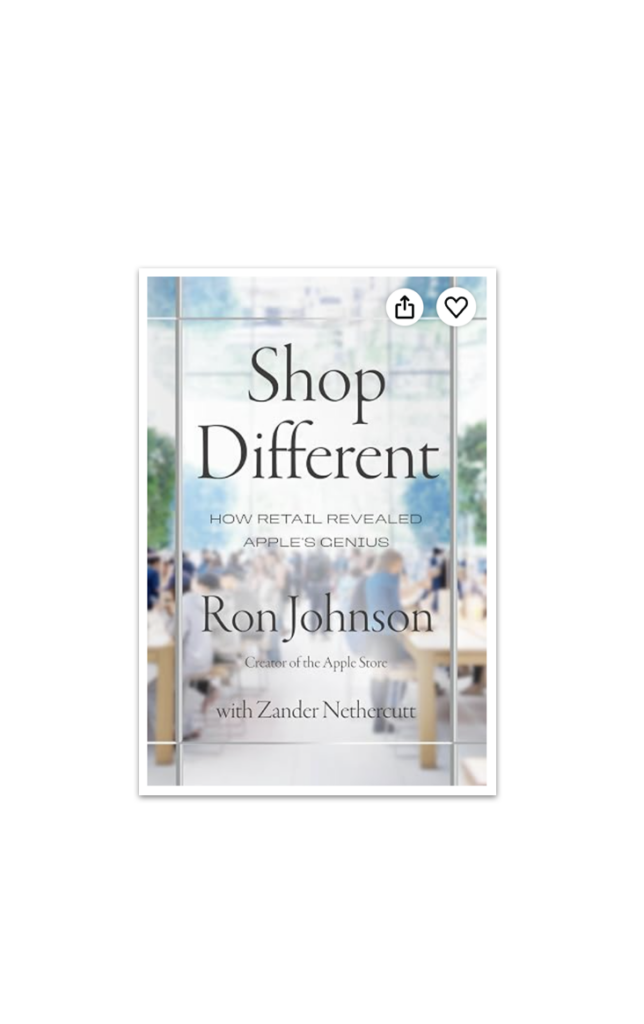
Authors: Ron Johnson and Zander Nethercutt
Publisher: Harper Business (2026)
Print Length: 320 pages
Reviewed by: James Kirchner
Ron Johnson has a pretty good story to tell.
He helped create the Apple Store. He worked closely with Steve Jobs. He helped turn the idea of an Apple retail operation from something many people thought was crazy into one of the most successful retail concepts in modern business. And then, just to make the story more interesting, he left Apple and tried to reinvent J.C. Penney.
That last part matters.
Because if Shop Different were simply another book about how brilliant Steve Jobs was and how Apple changed retail, it would be interesting but predictable. What makes Ron Johnson’s story worth reading is that he has experienced both extraordinary success and spectacular failure. And, to his credit, he doesn’t completely shy away from the latter.
The heart of Shop Different is Johnson’s creation of the Apple Store. When he joined Apple in 2000, conventional wisdom was that physical retail was headed for extinction. Why would anyone need an Apple store when computers could be purchased online or through established retailers?
Johnson and Jobs saw the problem differently.
Apple needed a place where customers could actually experience its products. The store wasn’t supposed to be a warehouse with cash registers. It was supposed to be a place where people could learn, experiment, get help and, eventually, become customers. The Genius Bar became an important part of that philosophy.
Johnson’s central retail lesson is simple: don’t focus on selling; focus on serving.
That sounds obvious today. It wasn’t nearly as obvious when Apple began building its stores.
One of the more interesting aspects of the book is Johnson’s description of his relationship with Jobs. Johnson portrays Jobs as demanding but also capable of giving talented people considerable responsibility once he trusted them. That is a somewhat different picture from the caricature of Jobs as someone who personally controlled every detail.
And Johnson clearly learned a lot from him.
But here is where I think Shop Different becomes more than an Apple love story.
Johnson eventually left Apple to become CEO of J.C. Penney in 2012. This was where the Apple magic ran into the very different reality of department-store retail.
Johnson arrived with enormous confidence and an ambitious plan. He wanted to eliminate the constant promotional pricing that had become part of J.C. Penney’s identity, simplify the stores, improve the customer experience and create something more modern. In effect, he wanted to apply some of the principles that had worked so brilliantly at Apple to a company with a completely different history, customer base and business model.
It didn’t work.
Johnson’s tenure lasted roughly two years, and J.C. Penney’s transformation unraveled badly. The lesson, in retrospect, seems obvious: what works at Apple cannot simply be transplanted into J.C. Penney.
But I give Johnson credit for including this chapter rather than writing around it.
In fact, I found the J.C. Penney section almost as interesting as the Apple material. Success can teach you what you did right. Failure can teach you what you misunderstood.
Johnson’s problem at J.C. Penney wasn’t that he lacked ideas. If anything, he may have had too many—and moved too quickly. He underestimated how deeply customers were attached to J.C. Penney’s traditional promotional model and how difficult it would be to change the habits of both customers and employees.
That is an important lesson for any business leader: a great strategy in one company isn’t necessarily a great strategy in another.
My biggest criticism of Shop Different is that I wanted more of that kind of self-examination.
Johnson is at his best when he is telling the behind-the-scenes story of Apple retail. I wanted more of the uncomfortable questions. Why exactly did the J.C. Penney strategy fail? Which assumptions were wrong? What would Johnson do differently today? And how much of the failure was strategic, cultural or simply a matter of execution?
The book does address his mistakes, but I still came away wanting Johnson to take the scalpel a little deeper.
There is also a larger question the book raises: how much of Apple Store’s success belongs to Johnson, and how much belongs to the unique combination of Apple, Jobs, technology and timing? Johnson makes a compelling case for his retail philosophy, but the Apple environment was hardly ordinary.
Still, I enjoyed Shop Different.
Johnson has earned the right to tell this story, and the Apple chapters provide a fascinating look at one of the most consequential retail experiments of the past quarter-century. More importantly, his J.C. Penney experience gives the book some humility that it otherwise might lack.
The biggest takeaway for me isn’t really about Apple stores.
It’s that great business ideas are rarely portable without modification.
Johnson figured out how to make people want to walk into an Apple Store. At J.C. Penney, he discovered that getting people to walk into a very different kind of store requires understanding what they already want—and why.
That may have been the most valuable lesson of his career.
Sometimes, the best business education comes not from the store that works, but from the one that doesn’t.
James Kirchner is the founder of ProseandCons.net and author of the Business Books column in Central Penn Business Journal and Lehigh Valley Business. A 37-year veteran of Morgan Stanley, he brings a practitioner’s perspective to his independent reviews and critiques of business books, leadership, technology and entrepreneurship. Visit ProseandCons.net for more.